1 in 7
breaks cut away while someone was still talking, measured at the real cut in the recording.†
SportsWall IQ is a monitor I built for live sports channels. It watches each channel the way a viewer gets it, raises an alarm when the picture or sound goes wrong, says where the fault most likely is, and tests its own detectors every night.
As of 30 October 2026
One Thursday evening a sports channel lost its right audio channel for about an hour and a half. The monitor raised an alarm 8 seconds after it went. The interesting part was the ad breaks: during every break both channels were fine, and the right one dropped again as soon as programme came back.
Programme audio as received
Right channel: digital silence
Right audio channel, 19:00 to 21:00
Programme, right channel deadAd break, both channels fineRestored
Six breaks, both channels fine in every one.
The loss, the restore and the first and last breaks (19:13 and 20:31) are to scale. The four breaks in between are spaced evenly here.
Before it points at the channel, the monitor checks the other places the fault could be.
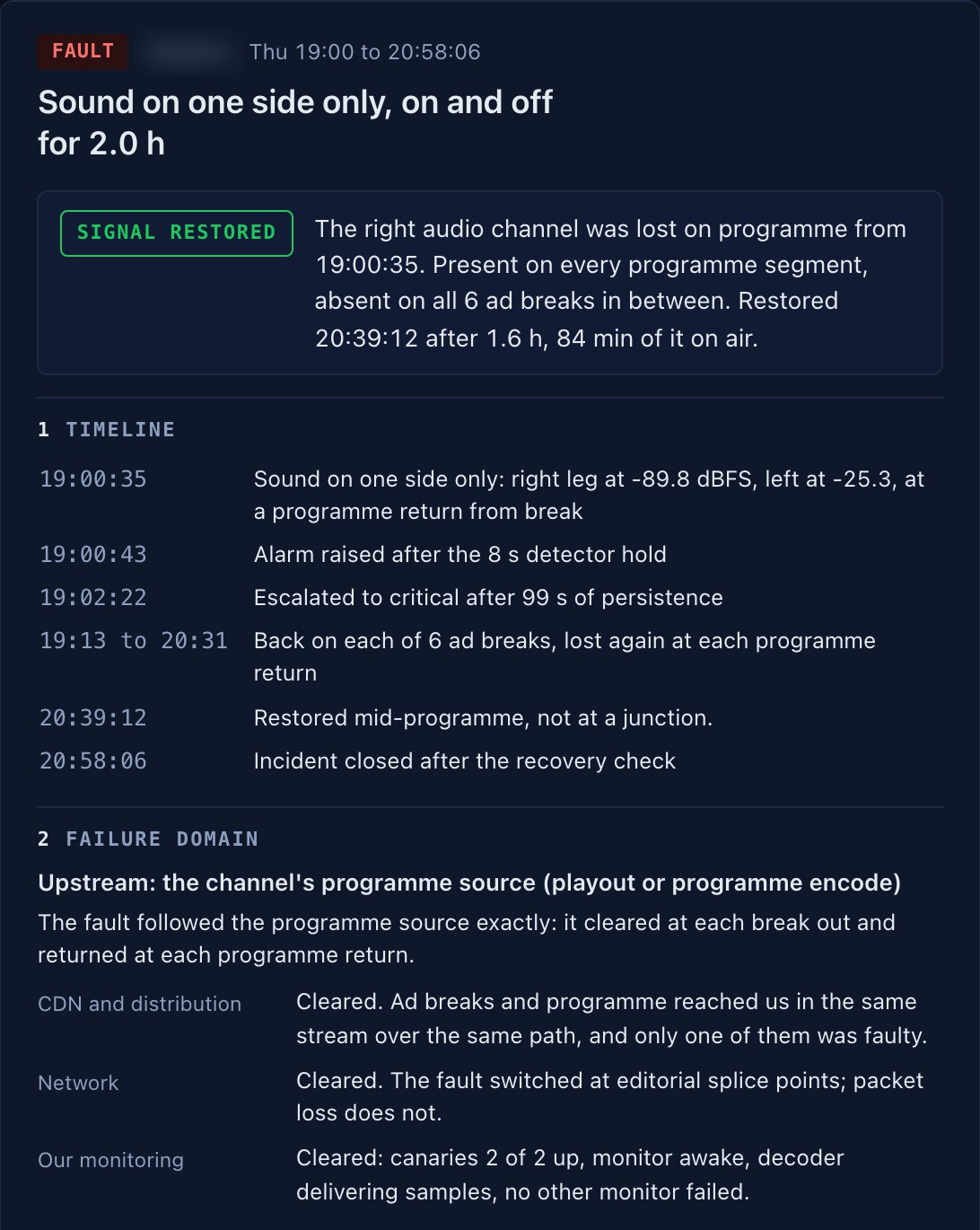
Incident report
This is the report the console wrote for that incident. I've blurred the channel's name.
Mid-morning, one channel's picture went to black. The alarm went off 12 seconds later with a clip attached, and the picture came back 6 seconds after that.
The 12 seconds is deliberate. Programmes fade to black between segments all the time, so the detector waits long enough to tell a fade from a real loss. The nightly self-test is how I check that the wait is set right.
 LiveBlack picture
On Friday 16 October I let it grade every ad break on 12 public sports channels for a full day: how each break started, what ran in it and how it came back to programme.
1 in 7
breaks cut away while someone was still talking, measured at the real cut in the recording.†
88%
of the adverts were repeats. One 15 second promo ran 159 times.
Half
the breaks had no advert in the feed I was watching, just a holding slate. 24 hours of it.*
227
breaks where the picture and the sound cut at different moments.
* Many FAST platforms insert adverts per viewer, on top of that slate. I tested two of the channels with four different TV identities and all four got the same slate the monitor saw. What a signed-in app inserts after that, I can't see.
† This page first said 4 in 10. That figure came from a flaw in how my software graded the cut: it timed each cut from the moment it saw the ad cue, which is often seconds away from the real cut. I found it, fixed it and measured the same day again at the cut the recording shows: 173 of 1,244 measurable breaks (14%). The other figures on this page were checked the same way and stand.
Every night at 02:00 it takes short recordings from each channel and plants faults into them: black, freeze, silence, one dead audio channel, total loss. It also plants things that look like faults but aren't, such as dark scenes, fades, held pictures and quiet moments. Then it scores itself on recordings it was never tuned on. A look-alike should never raise an alarm.
From the server's self-test: 14 held-out nights, 12 channels, as of 30 October 2026. Rates are rounded down.
Frozen picture is still below where I want it. The misses I've checked were a still graphic with live sound underneath. The monitor waits 60 seconds on those on purpose, because they're usually a scoreboard or a holding slate, and the planted freezes were shorter than that. When I planted the same ones again as longer freezes, every one raised the alarm.
There's no single overall percentage. Each type of fault has to reach 99% on its own, at 95% confidence, before I claim it. The ones that haven't got there say so. Today's numbers are on the live status page.
Every night the self-test runs these stages against planted faults. Machine learning models run in shadow until the results justify switching them on.
Detection is measurement and rules that can be checked line by line.
Models run alongside the rules and only go live on a channel once the evidence supports it. Break detection is live on 3 channels so far.
When it started, how long it was held before alarming, when it escalated and the likely cause, with a clip.
3,037 tests on my Mac, then the full suite again on the Linux server, before anything is deployed. A rollback image is kept every time.
I'm Guilherme Loureiro, a broadcast operator in master control in London. I built SportsWall IQ in my own time, using AI coding tools, because the question we ask all shift in MCR is whether what we think went to air actually went to air.
If you work in live sports video, I'd be glad to hear how you'd have handled the one-sided audio fault, or what you'd check first.